Essential Oils in Intimate Care: Safety, Dilution and What to Avoid
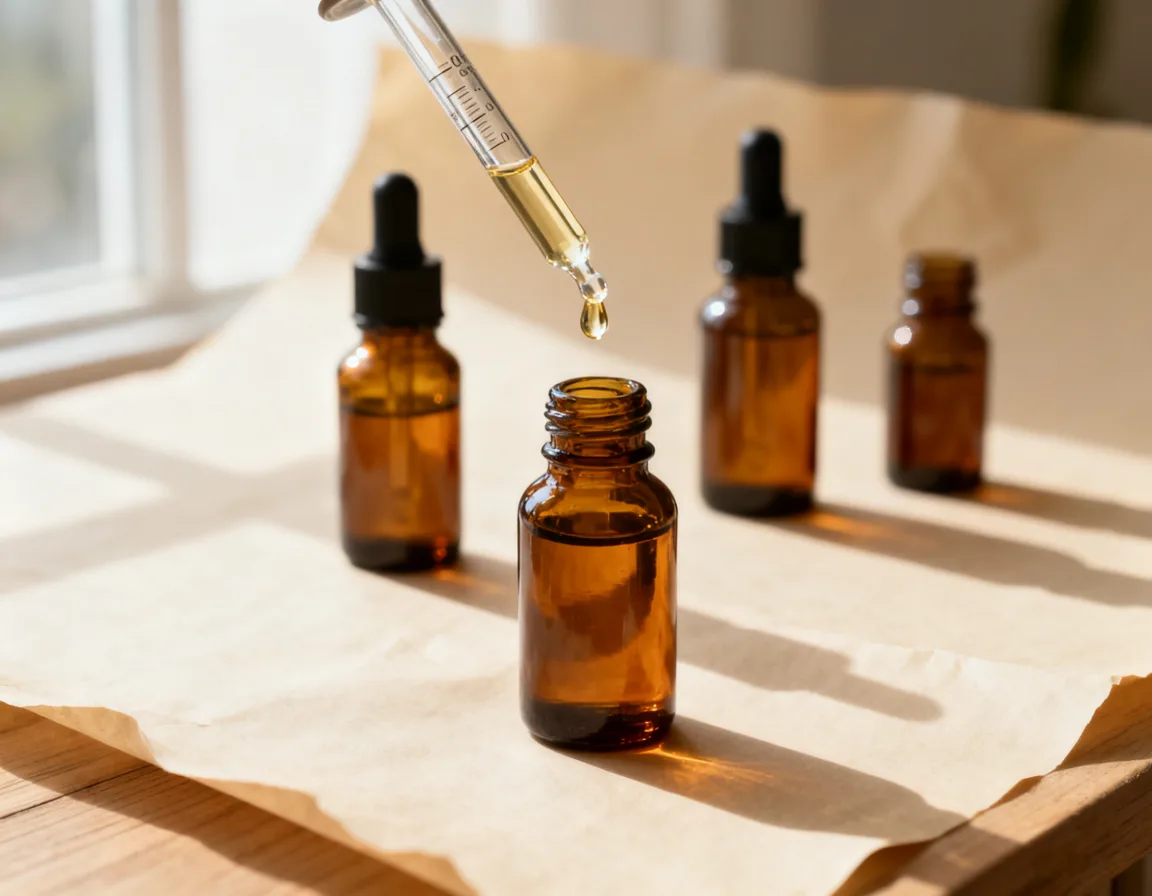
"It's natural" may be the most dangerous phrase in cosmetics. Essential oils are natural — and they are also concentrated chemistry: a single millilitre of rose otto contains the aromatic output of roughly ten thousand rose petals, distilled into a liquid dense with citronellol, geraniol and dozens of other active molecules. That is precisely what makes essential oils wonderful, and precisely why they demand respect. The old toxicologist's rule applies without exception: the dose makes the poison. Undiluted, many essential oils will burn skin. Properly diluted, the same oils are gentle enough for daily use on the most delicate skin on the body.
We sell essential-oil-infused intimate care, so we have an obvious interest in you trusting the category. We would rather earn that trust the honest way: by explaining exactly how dilution works, which oils we would never put near intimate skin, and which "natural" molecules are on the official allergen lists. By the end of this guide you will be able to audit any intimate oil on the market — including ours.
Why dilution matters more on intimate skin
Skin is not uniform. Its outermost layer — the stratum corneum, a stack of flattened cells bound in lipids — varies enormously in thickness: thick and tough on the palms, thin and permeable on the eyelids, genitals and other flexural areas. Vulvar skin sits firmly at the delicate end of that spectrum. Its barrier is thinner, it is naturally occluded by clothing (which increases absorption), and it is richly supplied with nerve endings that register irritation quickly.
The practical consequence: a concentration of essential oil that a forearm shrugs off can sting, redden or sensitize intimate skin. This is why professional aromatherapy guidance treats "sensitive and intimate areas" as a special case demanding the lowest dilutions of all [1], and why the reference text of the field — Tisserand and Young's Essential Oil Safety — devotes so much attention to matching dilution to body site and to the difference between a wash-off and a leave-on product [2].
There is a second, slower risk beyond immediate stinging: sensitization. Repeatedly exposing skin to too-high concentrations of fragrance molecules can teach the immune system to treat them as threats. Once sensitized, a person may react to even tiny amounts — permanently. Sensitization is dose-dependent and largely preventable, which is exactly what the international fragrance industry's IFRA Standards exist to manage: they set maximum concentrations for fragrance materials by product category, with leave-on products held to far stricter limits than rinse-off ones [3].
The 1% rule
Dilution is usually expressed as a percentage: the share of the finished product that is essential oil, with the rest being carrier oil. For quick mental math, aromatherapists use a working approximation of about 30 drops of essential oil per millilitre — so a 30 ml bottle of carrier holds roughly 900 drops' worth of volume, and each percentage point of dilution corresponds to about 9 drops of essential oil. That gives you this table:
| Dilution | Drops per 30 ml carrier | Appropriate for |
|---|---|---|
| 0.5% | ≈ 4–5 drops | Very sensitive skin, first-time users, facial and intimate skin |
| 1% | ≈ 9 drops | The ceiling we recommend for any leave-on intimate product |
| 2% | ≈ 18 drops | General body massage on non-sensitive skin — not intimate use |
Drop counts are approximations — droppers differ, and viscous oils drop larger — but the principle is exact: leave-on products for intimate skin should stay at or below 1% total essential oil content. Every scented product we make is formulated to that ceiling, and our unscented Original sits at a comfortable 0%.
Note the phrase total essential oil content. A blend of three oils at 0.5% each is a 1.5% product, not a 0.5% one. When you read a label, the question is not how gentle each ingredient sounds individually but how much aromatic material the formula carries in sum.
Oils and compounds to avoid entirely near intimate skin
Some essential oils have no business in intimate care at any dilution a cosmetic would realistically use. If you see these high on the ingredient list of an intimate product, put it back on the shelf:
- Cinnamon bark oil. Rich in cinnamaldehyde, one of the most potent skin sensitizers among natural materials. A "warming" sensation on intimate skin is not a feature; it is irritation in progress.
- Clove oil. Dominated by eugenol — pleasant in a bakery, aggressive on mucosa-adjacent skin.
- Oregano oil. Carvacrol-rich and frankly caustic on delicate skin; this is an oil even robust body-care formulators handle with caution.
- Thyme (thymol chemotype). Thymol shares oregano's harshness. Note that thyme comes in several chemotypes; the thymol type is the problem child.
- Peppermint in high doses. Menthol's cooling trick comes from activating cold-sensing nerve receptors — receptors that intimate skin has in abundance. What is refreshing on a tired calf can be genuinely painful on the vulva.
- Phototoxic cold-pressed citrus oils — bergamot above all. Cold-pressed bergamot contains bergapten, a furanocoumarin that reacts with UV light and can cause burn-like phototoxic reactions on skin later exposed to sun. If any citrus-scented product will meet sunlight (think beach days and swimwear lines), it needs to use distilled or furanocoumarin-free grades — or you should not use it before sun exposure.
None of these oils are "bad" — cinnamon bark is magnificent in a diffuser. They are simply wrong for this body site, and a formulator who includes them either has not read the safety literature or is chasing a sensation-based gimmick [2].
Known allergens hiding in natural oils
Here is the fact the "clean beauty" aisle rarely mentions: the most common fragrance allergens are natural molecules. The European Union's consumer-safety framework — informed by the Scientific Committee on Consumer Safety (SCCS) — requires 26 recognized fragrance allergens to be individually declared on cosmetic labels when they exceed threshold levels [4]. Scan that list and you find the very molecules that give beloved botanicals their character:
- Linalool — the soft heart of lavender.
- Limonene — the sparkle of every citrus peel.
- Citronellol and geraniol — the core of rose otto and geranium.
- Benzyl benzoate — naturally present in ylang-ylang and jasmine.
A rose essential oil is, chemically, a citronellol–geraniol delivery system. That does not make rose oil dangerous at proper dilution — the threshold logic exists precisely because dose determines risk — but it demolishes the comforting myth that natural means hypoallergenic. No fragrant material, however lovingly distilled, is allergen-free for every person.
Our position: we follow the EU declaration logic on our own labels, naming the allergens naturally present in each infusion — linalool in our Lavender & Chamomile, citronellol and geraniol in Rose, benzyl benzoate in Ylang-Ylang & Jasmine — so a person who knows their triggers can make an informed choice before the bottle is ever opened. It is a small printing cost for us and a real service to the roughly one-in-a-hundred people with diagnosed fragrance allergy.
Pregnancy and nursing
Pregnancy changes skin sensitivity, scent perception and — for some essential oil constituents — the safety calculus itself. The responsible position for any cosmetics brand is also the simple one: if you are pregnant or nursing, talk to your midwife, obstetrician or family doctor before adding any essential-oil product to your routine, intimate or otherwise. We print this advice on every product we sell, and the unscented Original exists partly for exactly this season of life, subject to your provider's guidance. For any intimate-health question during pregnancy, your clinician outranks every blog on the internet, including this one [5].
How Femme Evoke formulates
Everything above is the standard we hold ourselves to, so let us state it as a checklist you can verify against our own labels:
- Total essential oil content at or below 1% in every scented leave-on product — the intimate-skin ceiling, not the general body-massage one. That covers Rose, Vetiver, Lavender & Chamomile and Ylang-Ylang & Jasmine alike.
- An unscented option exists. The Original contains no essential oils at all — grapeseed, jojoba and vitamin E, nothing else. If your skin is reactive, if you are pregnant and your provider prefers you avoid fragrance, or if you simply want zero variables, that is the bottle for you.
- None of the avoid-list oils, ever. No cinnamon, clove, oregano, thymol-thyme, high-dose mint, no phototoxic cold-pressed citrus.
- Allergens declared, patch test always. Every label names its naturally occurring allergens and asks you to patch test for 48 hours before first use — our step-by-step ritual guide shows exactly how.
The bottom line
Essential oils are neither poison nor magic; they are potent plant chemistry that rewards respect. On intimate skin the rules are short: total dilution at or below 1%, no harsh or phototoxic oils at all, allergens named on the label, a patch test before first use, and a clinician — not a cosmetic — for anything that is actually a symptom. A brand that follows those rules deserves your consideration. A brand that will not tell you its dilution does not. We built our range to pass this audit, and we wrote this guide so you can run it on anyone — including us.
Sources
- National Association for Holistic Aromatherapy — Aromatherapy Safety Guidelines. naha.org
- Tisserand R., Young R. Essential Oil Safety: A Guide for Health Care Professionals, 2nd ed. Churchill Livingstone, 2014. tisserandinstitute.org
- International Fragrance Association — IFRA Standards for the safe use of fragrance materials. ifrafragrance.org
- European Commission — Scientific Committee on Consumer Safety (SCCS). health.ec.europa.eu
- American College of Obstetricians and Gynecologists — Vulvovaginal Health FAQ. acog.org
Sensitive skin? Start unscented
The Original Yoni Oil contains zero essential oils — just grapeseed, jojoba and vitamin E. The sensitive-skin choice, $39.