Why Grapeseed Oil? The Science Behind Our Base
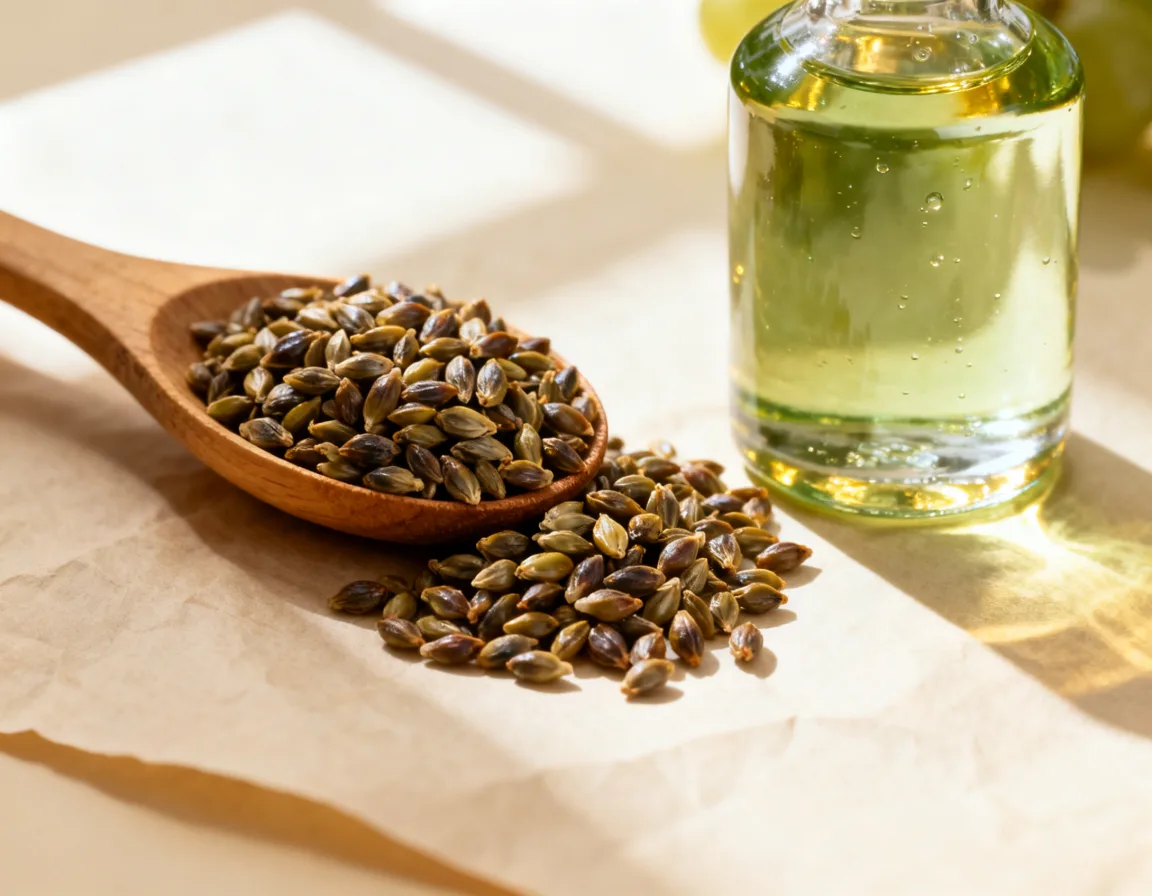
Every Femme Evoke bottle — the unscented Original, the rose, the vetiver, all of them — starts with the same first ingredient: cold-pressed grapeseed oil. It was not the romantic choice. Rosehip sounds prettier on a label, argan carries more prestige, coconut has better name recognition. We chose grapeseed anyway, and this article is the full argument: what the oil is, what is actually in it, what the skin barrier research says about oils like it — and, because we promised honesty on this site, the downsides we work around rather than hide.
What grapeseed oil actually is
Grapeseed oil is a byproduct of winemaking. After grapes are pressed for wine, the seeds remain — millions of tonnes of them worldwide each year — and each small seed holds roughly 10–20% oil by weight. Historically those seeds were waste; pressing them recovers an oil with a remarkably useful composition for skin care [1]. There is something we like about that origin story: nothing was grown specially for our bottles, and a discard stream from one craft became the foundation of another.
How the oil is extracted matters. Industrial grapeseed oil is often solvent-extracted and heavily refined for the kitchen. The grade we use is cold-pressed: seeds are mechanically pressed without added heat or solvents, which preserves more of the minor compounds — vitamin E and phenolics among them — that refining strips away [1].
The fatty acid profile — where oils really differ
Strip away the marketing and a carrier oil is its fatty acid profile. Two acids do most of the talking. Linoleic acid is a polyunsaturated omega-6 fat that human skin cannot make and must obtain from outside; it is lightweight, fast-absorbing, and a raw material of the skin barrier. Oleic acid is the monounsaturated fat that dominates olive oil; it feels richer, but in high concentrations it can disrupt the very barrier you are trying to support. Here is how the common carrier oils compare, using approximate published ranges:
| Oil | Linoleic acid | Oleic acid | Character on skin |
|---|---|---|---|
| Grapeseed | ~66–75% | ~14–20% | Very light, fast-absorbing, non-greasy [1] |
| Sunflower (high-linoleic) | ~48–74% | ~14–40% | Light; preserved adult skin barrier in a controlled study [3] |
| Olive | ~4–20% | ~55–83% | Rich, slow to absorb; damaged the skin barrier in the same study [3] |
| Coconut | ~1–3% | ~5–8% | Mostly saturated (lauric); solid below ~24 °C, occlusive, very shelf-stable |
| Jojoba | <5% | ~5–15% | Technically a liquid wax ester, structurally close to skin sebum; exceptionally stable |
Figures are approximate ranges from the published literature; every harvest and pressing varies. The pattern, though, is stable: grapeseed sits at the top of the linoleic table, olive near the bottom, and that difference is not cosmetic trivia — it is the whole argument.
Why linoleic acid matters for the skin barrier
Your outermost skin layer, the stratum corneum, works like brick and mortar: corneocyte "bricks" in a "mortar" of lipids, a large share of which are ceramides. Linoleic acid is a building block of the most barrier-critical ceramides. Skin deprived of it becomes scaly and leaky — it loses water faster — and, notably, the deficiency signs can be corrected by topical application of linoleic-acid-rich oils, not only by diet [2].
Two more strands of evidence shape our choice:
- The Danby study. Adult volunteers applied olive oil or high-linoleic sunflower seed oil to their forearms for four weeks. Olive oil — high-oleic, low-linoleic — reduced stratum corneum integrity and caused mild redness; the sunflower oil preserved barrier integrity and improved hydration [3]. Same shelf, opposite effects, and the dividing line was the fatty acid profile.
- The broader plant oil literature. A 2017 review of topical plant oils describes how linoleic-rich oils support barrier repair and skin homeostasis, while high oleic acid content is associated with barrier disruption and increased permeability [4].
Grapeseed itself has been studied far less on skin than sunflower or coconut — we say so plainly. Our reasoning is explicitly an inference: the barrier research points to high-linoleic oils as a class, and grapeseed is one of the most linoleic-rich oils that is also light, stable enough with help, and pleasant to use. For skin as delicate as the external intimate area — which deserves the same gentleness ACOG urges in avoiding harsh or irritating products on vulvar skin [5] — we would rather stand on a well-supported class inference than on a poetic origin story.
Olive oil taught the industry a lesson: two "natural" oils can have opposite effects on skin. The fatty acid profile, not the word natural, is what matters.
Texture: why light matters here
Composition would count for little if the oil felt wrong. Grapeseed is among the lightest carrier oils there is — low viscosity, quick to spread, absorbed without a lingering film. For intimate skin that spends the day against underwear, this is not a luxury preference: a heavy, occlusive oil in a warm, covered area is a recipe for clogged follicles and discomfort. Grapeseed is also conventionally ranked among the least comedogenic carrier oils — another consequence of the same lightweight, linoleic-dominant composition. It sinks in, does its emollient work, and gets out of the way.
The honest downsides
No ingredient is all upside, and a brand that claims otherwise is editing. Three things we actively manage:
- It oxidizes faster than saturated oils. The polyunsaturated bonds that make linoleic acid valuable also make it reactive with oxygen, light and heat. Coconut oil can sit in a clear jar for two years; grapeseed cannot. This is exactly why every Femme Evoke formula includes vitamin E — an antioxidant that grapeseed oil naturally carries and that we top up [1] — and why we bottle in dark glass, in small batches, with a stated shelf life. Store it away from sunlight and heat, and use it within its window.
- It has a scent of its own. Cold-pressed grapeseed carries a faint nutty, green note. We think it is pleasant and it fades within minutes, but "unscented" here means "no added fragrance," not "odourless in the bottle" — a distinction worth making before you first open the Original.
- It is not a miracle ingredient. Grapeseed oil contains studied compounds — proanthocyanidins, phenolics, vitamin E — but much of that research concerns dietary or laboratory contexts, not oil massaged into vulvar skin [1]. What our base reliably delivers is excellent emollience with the right fatty acid profile. Anything more we treat as a possible bonus, never a promise — and for what the category as a whole can and cannot do, our benefits article grades every claim against the evidence.
Why we pair it with jojoba
The second ingredient in our base solves the first downside. Jojoba is not chemically a triglyceride oil at all — it is a liquid wax ester, structurally similar to the sebum human skin produces, and wax esters are exceptionally resistant to oxidation. Blended with grapeseed, jojoba slows the overall oxidation of the formula, adds a silky slip that pure grapeseed lacks, and behaves familiarly on skin precisely because skin makes something like it. Grapeseed brings the linoleic acid; jojoba brings the stability and glide; vitamin E guards them both. That three-part base is the entire ingredient list of our Original Yoni Oil — the scented infusions add only steam-distilled essential oils at or below 1%, a threshold we explain in our essential oil safety guide.
The bottom line
We chose grapeseed oil because the skin barrier literature points, consistently, toward light, high-linoleic oils — and away from some prettier-sounding alternatives. It is a modest ingredient with an honest job: moisturize, soften, protect the surface of external intimate skin. We manage its real weaknesses with vitamin E, jojoba and dark glass rather than pretending they do not exist. And as always: it is a cosmetic, not a treatment — anything that itches, burns or worries you belongs in front of a clinician, not under more oil [5].
Sources
- Garavaglia J. et al. Grape Seed Oil Compounds: Biological and Chemical Actions for Health. Nutrition and Metabolic Insights, 2016. PMC
- Linus Pauling Institute, Oregon State University — Essential Fatty Acids and Skin Health. lpi.oregonstate.edu
- Danby S.G. et al. Effect of olive and sunflower seed oil on the adult skin barrier: implications for neonatal skin care. Pediatric Dermatology, 2013. PubMed
- Lin T.K., Zhong L., Santiago J.L. Anti-Inflammatory and Skin Barrier Repair Effects of Topical Application of Some Plant Oils. International Journal of Molecular Sciences, 2017. PMC
- American College of Obstetricians and Gynecologists — Vulvovaginal Health FAQ. acog.org
Meet the base itself
The Original Yoni Oil — grapeseed, jojoba, vitamin E. Unscented, $39.